


Blog
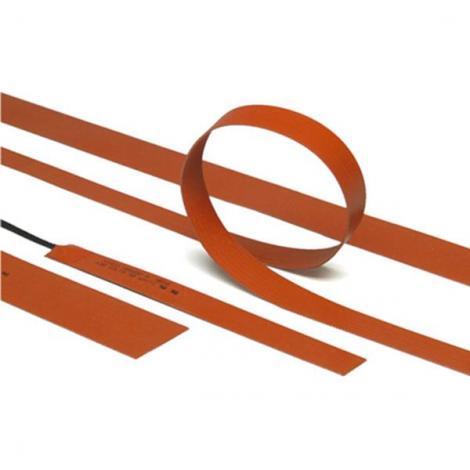
A practical guide to preventing condensation in electric motors using flexible, surface-mounted silicone rubber heaters.
For available sizes, voltage ratings and ordering information, see our Electric Motor Anti-Condensation Wire-Wound Silicone Rubber Heaters.
Introduction
Moisture and condensation are common causes of premature insulation deterioration and electrical failures in industrial electric motors. Motors operating in humid environments, exposed to fluctuating temperatures, or remaining idle for extended periods are particularly vulnerable.
To protect against condensation, many large electric motors are equipped with electric space heaters. Traditionally, these have been tubular or strip-style heating elements mounted inside the motor enclosure. However, flexible silicone rubber heaters offer an alternative that can provide more direct heating of the motor windings, compact installation, and potentially lower energy consumption.
When properly selected and installed, silicone rubber heaters can be used as anti-condensation heaters in both new motor designs and retrofit applications.
Why Electric Motors Need Anti-Condensation Heaters
Condensation can form inside an electric motor when internal surfaces cool below the dew point of the surrounding air.
This can occur when:
- A motor is shut down after operating at an elevated temperature.
- Ambient temperatures fluctuate significantly between day and night.
- A motor operates in a humid or coastal environment.
- Equipment remains idle for extended periods.
- A motor is exposed to seasonal temperature changes or damp industrial conditions.
Moisture accumulating on motor windings can reduce insulation resistance, contribute to corrosion, and accelerate deterioration of the winding insulation system.
Anti-condensation heaters help prevent these problems by maintaining the motor's internal temperature above the surrounding air's dew point while the motor is not operating.
The objective is not to heat the motor to its normal operating temperature. Instead, it is to provide enough heat to prevent moisture from condensing on vulnerable internal surfaces.
Traditional Tubular Space Heaters
Tubular space heaters have been used in industrial motors for decades.
These heaters typically consist of a resistance heating element enclosed in a metal sheath. They are mounted inside the motor housing, where they warm the surrounding air through convection and radiation.
The heated air circulates within the motor enclosure, helping maintain the temperature of the windings and other internal components.
Advantages
- Proven technology with a long history of use.
- Available in numerous lengths, voltages, and wattages.
- Can heat the general internal environment of the motor.
- Suitable for many industrial motor designs.
Limitations
- Require physical mounting space inside the motor enclosure.
- Heat transfer to the windings is indirect.
- Heat distribution can be uneven depending on heater location and internal airflow.
- Replacement may be difficult when the original heater is obsolete or unavailable.
- Higher heater wattage may be necessary in some installations compared with direct-contact heating.
These limitations have encouraged the use of flexible surface-mounted heaters as an alternative.
Silicone Rubber Heaters: An Alternative for Motor Windings
Silicone rubber heaters are thin, flexible electrical resistance heaters designed to conform to curved and irregular surfaces.
They typically incorporate an electrical heating element encapsulated within silicone rubber insulation.
Unlike conventional tubular heaters, silicone rubber heaters can be installed directly against suitable insulated surfaces of the motor winding end turns when that installation is approved for the specific motor and heater.
Confirm the mounting method: The Mod-Tronic motor-heater product page describes wrapping the heater around the inside of the motor housing. Direct contact with winding end turns is an application-specific installation that must be confirmed with the motor manufacturer or qualified motor repair facility, including compatibility with the winding insulation and retention materials.
This arrangement transfers heat primarily through conduction into the winding structure, while also warming the surrounding internal air.
Key advantages
1. More direct heat transfer
By mounting the heater directly against the insulated winding surface, heat can be transferred efficiently into the winding structure.
This may allow the same anti-condensation objective to be achieved with less electrical power, depending on the motor's construction and operating environment.
2. Flexible installation
Silicone rubber heaters can conform to the curved surfaces of motor winding end turns.
Their thin construction makes them particularly useful where space for conventional tubular heaters is limited.
3. Distributed heating
Multiple silicone rubber heaters can be positioned at different locations around the winding assembly.
For example, installing one heater at each end of the stator can provide more balanced winding heating than a single heater installed near one end of the motor.
4. Customizable dimensions and wattages
Silicone rubber heaters can be manufactured in a variety of lengths, widths, voltages, and wattages.
This flexibility allows motor repair facilities and OEMs to select a heater configuration suited to the available winding surface and the required heating output.
5. Retrofit opportunities
When a traditional tubular heater fails or becomes obsolete, silicone rubber heaters may provide a practical replacement without requiring an identical tubular element.
However, any retrofit must account for the original heater's function, the motor's insulation system, and applicable electrical and safety requirements.
Comparing Tubular and Silicone Rubber Motor Heaters
| Feature | Tubular Space Heater | Silicone Rubber Winding Heater |
|---|---|---|
| Typical mounting | Inside motor enclosure | On insulated winding end turns |
| Primary heat transfer | Convection and radiation | Conduction and convection |
| Construction | Rigid metal-sheathed element | Thin, flexible silicone rubber |
| Space requirements | Requires clearance and mounting hardware | Low-profile installation |
| Heat distribution | Depends on heater location and air circulation | Can be distributed across winding surfaces |
| Available configurations | Standard and custom lengths and wattages | Custom lengths, widths, voltages, and wattages |
| Retrofit suitability | Often requires matching physical dimensions | May offer greater installation flexibility |
| Power consumption | Depends on motor and application | May be lower with effective direct-contact heating |
Neither design is universally superior. The best solution depends on the motor construction, enclosure, operating environment, and required heating performance.
Selecting the Correct Wattage
One of the most important considerations when replacing a tubular space heater with silicone rubber heaters is determining the appropriate wattage.
It is tempting to assume that the replacement heater must have exactly the same wattage as the original.
However, this is not always necessary.
Because silicone rubber heaters can transfer heat directly into the winding structure, they may achieve the required anti-condensation performance with less total electrical power.
Nevertheless, there is no universal conversion factor between tubular heater wattage and surface-mounted heater wattage.
Factors that influence the required heating power include:
- Motor size and thermal mass.
- Motor enclosure type and ventilation.
- Ambient temperature and humidity.
- Expected minimum temperatures.
- Heater location and available mounting area.
- Thermal contact between the heater and winding.
- Required temperature margin above the dew point.
A practical approach is to begin with a conservative wattage selection and verify performance through temperature measurements under representative environmental conditions.
The ultimate objective is to keep vulnerable internal surfaces above the dew point without overheating the winding insulation or heater assembly.
Understanding Heater Watt Density
When selecting silicone rubber heaters, total wattage is only part of the equation.
Watt density describes how much electrical power is generated per unit of heater surface area.
Watt density (W/in²) = Heater wattage ÷ Heated surface area (in²)
For example, consider a silicone rubber heater measuring 1 inch wide by 30 inches long, rated at 150 watts.
Its nominal watt density at rated voltage is:
150W ÷ 30 in² = 5 W/in²
This uses the nominal overall heater area; use the manufacturer’s active heated area when it differs.
However, when two identical resistive heaters are connected in series across a supply equal to each heater's rated voltage, each heater receives approximately half its rated voltage.
Under these conditions, each heater produces approximately one-quarter of its rated wattage.
This reduces both the total heating output and the operating watt density.
Lower watt density can be beneficial for winding-mounted heaters because it reduces concentrated heat generation. However, actual heater temperature also depends on thermal contact, winding construction, and heat dissipation.
Example: Replacing a Tubular Heater with Two Silicone Rubber Heaters
Consider a large industrial motor equipped with a conventional tubular space heater having the following specifications:
- Length: 72 inches
- Voltage: 110 VAC
- Power: 90 watts
An alternative configuration could use two flexible silicone rubber heaters, each measuring 1 inch wide by 30 inches long.
Assume each silicone heater is rated at 150 watts at 110 VAC.
By connecting the two identical heaters in series across the existing 110V supply, the operating voltage and wattage are reduced.
| Specification | Existing Tubular Heater | Two Silicone Rubber Heaters |
|---|---|---|
| Quantity | 1 | 2 |
| Dimensions | 72" long | 1" × 30" each |
| Supply voltage | 110 VAC | 110 VAC |
| Individual rated wattage | 90W | 150W at 110V |
| Actual voltage per heater | 110V | 55V |
| Actual wattage per heater | 90W | 37.5W |
| Total operating wattage | 90W | 75W |
| Operating watt density | Depends on construction | 1.25 W/in² |
In this example, the replacement arrangement provides approximately 83% of the original heater's electrical power.
The two silicone rubber heaters could be positioned on opposite winding end turns, distributing the heating across the motor.
Because the heaters transfer heat directly into the winding structure, the lower total wattage may still provide adequate condensation protection.
Important: This example illustrates the electrical calculations and a possible retrofit configuration. It does not establish that 75 watts will be sufficient for every motor previously equipped with a 90-watt tubular heater. Temperature testing is necessary to confirm performance.
The calculation also assumes identical heaters with approximately constant electrical resistance. Manufacturer specifications should be consulted before operating heaters below their rated voltage or connecting them in series.
Using a Listed 120 V Heater on a 110 V Supply
The 75 W result above assumes each heater is rated 150 W at 110 V. The standard Mod-Tronic HR1X30V120W150 model is instead rated 150 W at 120 V and measures 1 × 30 inches. For two identical units in series, use the actual nameplate voltage:
Total power = 2 × rated watts × [supply volts ÷ (2 × rated volts)]²
At a 110 V supply, two 150 W, 120 V heaters in series produce approximately 63 W total, or 31.5 W per heater, at a nominal 1.05 W/in². At a 120 V supply, the same pair produces 75 W total. These are electrical estimates for approximately constant resistance; they do not establish adequate anti-condensation performance for a particular motor.
Series vs. Parallel Wiring
Silicone rubber heaters can be connected in series or parallel, provided the arrangement is compatible with their electrical ratings and the available power supply.
Series wiring
When two identical resistance heaters are connected in series:
- Each heater receives approximately half the supply voltage.
- Each produces approximately one-quarter of its rated wattage when the supply equals the individual rated voltage.
- The combined output is approximately half the rated wattage of one heater when the supply matches the individual heater’s rated voltage.
- If either heater fails open, both heaters stop producing heat.
Series wiring can therefore provide a practical way to reduce the operating wattage of certain heater designs.
Parallel wiring
When two identical heaters are connected in parallel:
- Each heater receives the full supply voltage.
- Each operates at its rated wattage when the supply matches its rating.
- Total power is the sum of both heaters.
- If one heater fails open, the other may continue operating.
The appropriate configuration depends on the desired total wattage, heater voltage ratings, and reliability requirements.
For critical applications, heater circuit monitoring may be desirable to detect failures.
Installation Considerations for Winding-Mounted Heaters
Proper installation is essential to the safety and effectiveness of silicone rubber motor heaters.
Mounting location: Heaters should be installed against suitable insulated winding surfaces, typically on the stator winding end turns. They should not be installed against exposed electrical conductors.
Thermal contact: Good contact between the heater and winding improves heat transfer and helps avoid localized overheating. Adhesives, insulating tapes, or mechanical retention methods must be compatible with the motor's insulation system.
Temperature rating: The heater materials, leads, adhesives, and insulation must tolerate the maximum temperatures encountered during motor operation, including periods when the anti-condensation heater is switched off.
Heater overlap: Silicone rubber heating elements should not overlap or fold onto themselves unless specifically designed and approved for that installation.
Electrical protection: Heater circuits should incorporate suitable overcurrent protection and wiring methods. Anti-condensation heaters are normally interlocked so that they are energized only when the motor is stopped.
Hazardous locations: Motors installed in hazardous locations may require specially approved heaters and installation methods. Modifications must not compromise the motor's certification.
Testing: After installation, insulation resistance, heater current, and operating temperatures should be verified. Temperature measurements should confirm adequate condensation protection without creating excessive local winding temperatures.
Can Silicone Rubber Heaters Reduce Energy Consumption?
Potentially, yes.
A silicone rubber heater installed directly on the winding may require less power than a conventional heater that warms the motor indirectly.
However, energy savings depend on the specific installation.
For example, replacing a continuously energized 90W tubular heater with a 75W silicone rubber heater arrangement reduces power consumption by approximately 16.7% during energized periods.
If the heaters operate for 4,000 hours annually:
- Original tubular heater: 360 kWh
- Silicone rubber heaters: 300 kWh
- Annual reduction: 60 kWh
Although the direct electricity savings may be modest for an individual motor, the benefits can become more meaningful across facilities operating many motors.
Additional advantages may include easier installation in certain motor designs and greater flexibility when replacing obsolete heating elements.
The primary benefit, however, remains reliable condensation prevention and protection of the motor winding insulation system.
Conclusion
Flexible silicone rubber heaters provide a practical alternative to traditional tubular space heaters for many industrial electric motor applications.
Their ability to conform to winding surfaces and transfer heat directly into the winding structure makes them particularly attractive for motor manufacturers, repair facilities, and retrofit projects.
Using two smaller heaters rather than one large element can also provide greater installation flexibility and more distributed heating.
However, proper heater selection requires more than simply matching the original wattage. Heater dimensions, watt density, electrical configuration, insulation compatibility, and operating conditions must all be considered.
With appropriate engineering and testing, silicone rubber winding heaters can provide effective anti-condensation protection while potentially reducing space requirements and electrical power consumption.
Need Help Selecting a Motor Winding Heater?
Mod-Tronic Instruments Limited has been supplying temperature sensors, heaters, and related products to the electric motor industry for over 50 years.
Our technical team can assist motor manufacturers and repair facilities with the selection of silicone rubber heaters for winding anti-condensation applications, including custom sizes, voltages, and wattages.
Contact Mod-Tronic Instruments Limited to discuss your motor heater requirements or a potential replacement for an existing tubular space heater.
Browse our Electric Motor Anti-Condensation Wire-Wound Silicone Rubber Heaters, or contact Mod-Tronic for application assistance.



